How to store water at home
How much, in what and for how long – simple advice for water storage.
By Nordic Ready Guide · Published · Updated
How much do you need?
The authorities count on 3–5 litres of water per person per day for drinking and cooking. Allow at least 3 litres. For a week that comes to at least 21 litres per person – at least 84 litres for a family of four.
Children, older people and people who are ill may need more, and more is used on warm days. Do not forget your pets. Work out what your household needs in the emergency kit calculator.
Save drinking water for the right things
You use more water than you think when the tap runs dry: hand washing, washing up and the toilet. Save the drinking water for drinking and food. Water in the bath or in buckets can be used to flush the toilet and for basic washing.
Bottles and water containers
Use clean bottles and containers intended for food use, with a lid that closes tightly. Containers with a tap are practical both for storage and for fetching water. Several smaller containers are easier to carry than one large one – 10 litres of water weighs 10 kilos.
Rinse the container before filling it. Washing-up liquid is fine as long as you rinse it out thoroughly afterwards. According to the Swedish Food Agency, chlorine is not normally needed. Read more in Water containers for your emergency kit.
Storage and how long the water keeps
Store the water somewhere cool and dark, tightly sealed, and label the containers with the date. According to the Swedish Food Agency's risk assessment, the risk of becoming ill from stored tap water is very low if the container is clean and sealed. What can happen instead is that the taste and smell get worse, especially if the water is kept somewhere warm.
The Swedish Food Agency refers to the advice to replace the water about every six months. Shop-bought bottled water keeps longer – follow the date on the packaging.
Freeze water in bottles
You can freeze water in PET bottles. Do not fill them right to the top, as water expands when it freezes. Frozen bottles also help the freezer stay cold during a power cut – see When the power goes out.
Collecting water from the municipality
During a longer outage, your municipality may put out water tanks or open water points. Bring clean containers with lids and follow the municipality's information online, on local radio and in the Krisinformation app.
When tap water cannot be relied on
If your municipality issues a boil-water notice, follow it. Bring the water to a rolling boil and let it cool in a clean container, preferably in the fridge. Use it for drinking, cooking, brushing your teeth and rinsing fruit and vegetables.
An outdoor water filter removes bacteria and parasites, but not viruses or chemicals, so it does not replace your municipality's advice. However, as a backup for water from lakes and streams, for example on a trip, a filter is a useful addition – read Water filters for your emergency kit.
Frequently asked questions
How much water should you keep at home? At least 3 litres per person per day, for at least a week. That is at least 21 litres per person and 84 litres for a family of four.
How long can you store tap water? Stored clean, cool, dark and sealed, the risk is very low even after a long time. The Swedish Food Agency refers to the advice to replace the water about every six months.
Do you need to add chlorine to the water? No, not normally. The most important thing is that the container is clean and the lid seals tightly.
Can you freeze water in PET bottles? Yes. Do not fill them right to the top, as water expands when it freezes.
Which containers should you choose? Containers intended for food use with a tight lid. A tap is practical, and several smaller containers are easier to carry than one large one.
Can you drink water from lakes and streams? Boil it first, or use a filter as an extra step. An ordinary outdoor filter does not remove viruses or chemicals.
Products in this guide
Sawyer Mini
Long service life · ca 400 kr

Katadyn BeFree 1,0 L
Fast flow, easy to clean · ca 792 kr
LifeStraw Personal
Low-cost emergency kit backup · ca 280 kr
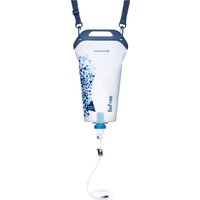
Katadyn BeFree Gravity 3,0 L
Treat water for the whole household · ca 1,049 kr
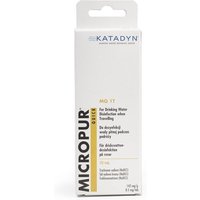
Katadyn Micropur Quick MQ 1T
Low-cost backup, 4-year shelf life · ca 149 kr

GSI Outdoors Water Cube 10 L
Easy to carry · ca 208 kr
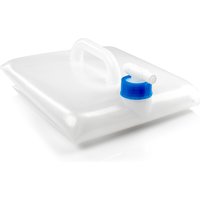
GSI Outdoors Water Cube 20 L
Bigger supply at home · ca 240 kr
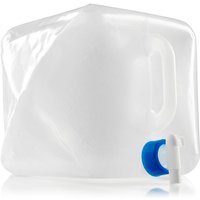
GSI Outdoors Water Cube 15 L
Mid size · ca 218 kr
Show more products (6)
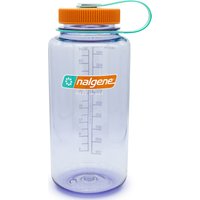
Nalgene 1L Wide Mouth Sustain
Durable water bottle · ca 177 kr

MSR Autoflow Basecamp XL 10 L
Large filter to hang up · ca 1,500 kr
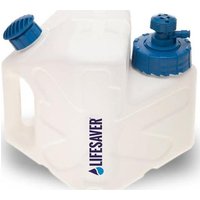
LifeSaver Cube
Purifies 5 litres at a time · ca 1,886 kr
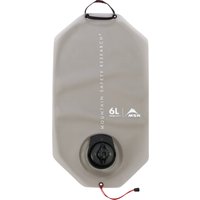
MSR DromLite Bag 6 L
Light water bag that takes little space · ca 595 kr
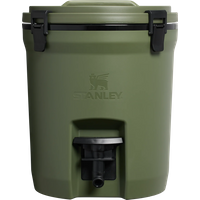
Stanley Fast-Flow Water Jug 7,5 L
Jug with tap for the whole group · ca 959 kr
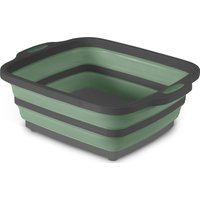
GSI Outdoors Escape Collapsible Sink
Washing up without running water · ca 192 kr
Prices are approximate and may change. Always check with the retailer.
Prices at Outnorth were checked on 24 November 2026.
Sources
Read also: Water containers – comparing Jula, Biltema and Outnorth (5–25 litres) · Water filters and purification for your emergency kit – LifeStraw, Katadyn and Sawyer · Build your emergency kit step by step
Related guides
Water filters and purification for your emergency kit – LifeStraw, Katadyn and Sawyer
A water filter or purification tablets can be a good backup if you do not have enough stored water. Here we compare filters and tablets and go through what they can – and cannot – do.
Read guideWaterWater containers – comparing Jula, Biltema and Outnorth (5–25 litres)
Clean water is the most important part of an emergency kit. Here we compare water containers from Jula and Outnorth, look at Biltema and go through size, taps, collapsible or rigid – and how to store the water.
Read guideCommunication & lightBe seen in the dark – reflectors, hi-vis vests and safety lights
With reflectors, a driver can see you at about 125 metres – without them and in dark clothes, only at 20–30 metres. How to wear reflectors properly, plus 20 products for adults, children, dogs and your tent.
Read guide